March 16, 2026 Manisha Maurya
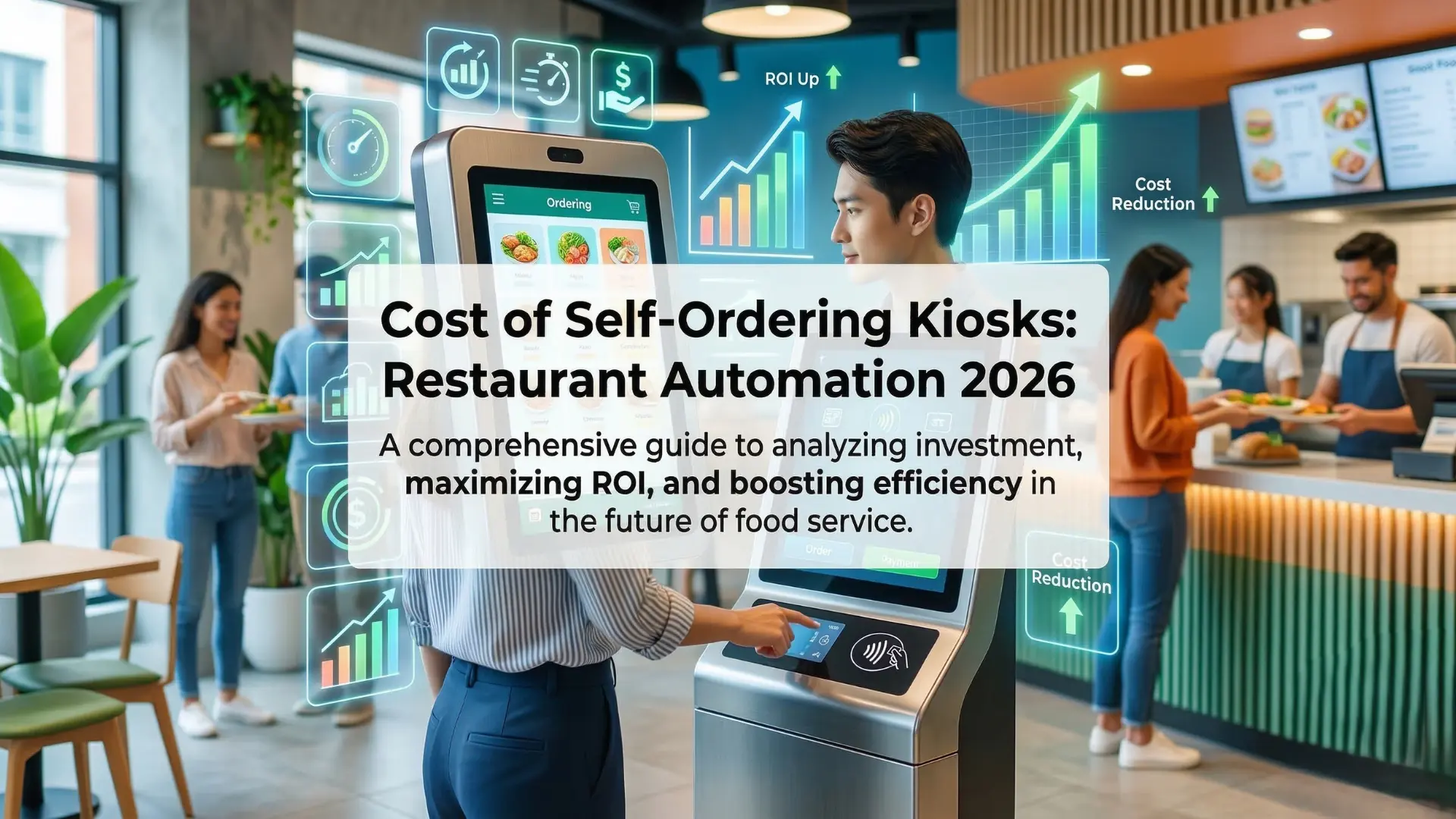
Running a restaurant has never been for the faint of heart, but recent years have tested even the most seasoned operators. Between fluctuating food costs and an unpredictable labor market, the pressure on your profit margins is incredibly real.
However, in 2026, the conversation around restaurant automation has shifted. It is no longer about replacing the human touch; it’s about providing digital infrastructure that allows your staff to focus on hospitality rather than punching in orders. If you are wondering whether the investment makes sense for your business, this guide breaks down the real costs and trends of self-ordering kiosks today.
When budgeting for a kiosk system, you need to look at the total cost of ownership. The investment is generally split into three main buckets: hardware, software, and implementation. (Note: The figures below have been adjusted to reflect realistic 2026 market pricing in INR).
The physical machine is your largest initial expense. Depending on your needs, a single unit can range from ₹25,000 to ₹1,20,000.
The hardware cost fluctuates heavily based on the form factor you choose for your dining room.
You have to balance your available square footage with how noticeable you want the technology to be.
Countertop Tablets (₹15,000 – ₹35,000): A low-cost, small-footprint option perfect for cafes and tight spaces.
Wall-Mounted Units (₹35,000 – ₹65,000): Excellent for saving floor space while remaining at eye level for the customer.
Freestanding Kiosks (₹65,000 – ₹1,20,000): These are the highly visible, traditional totems you see in major QSRs (Quick Service Restaurants). They command attention and easily withstand heavy daily use.
Most modern kiosks operate on a Software-as-a-Service (SaaS) model. You pay a recurring fee for the interface, continuous updates, and security patches.
Monthly Licenses: Expect to pay between ₹2,000 and ₹8,000 per device, per month.
Payment Processing: Just like your POS, expect standard payment gateway processing fees (typically 1.5% to 2% per transaction).
Don't overlook the hidden costs of bringing the system online.
Installation: Cabling, secure mounting, and network setup usually cost between ₹2,500 and ₹8,000.
POS Integration: Some legacy Point of Sale systems charge a one-time API "bridge" fee to connect with third-party kiosks.
Maintenance: Budget around ₹5,000 to ₹15,000 annually for potential screen repairs, receipt printer paper, and hardware upkeep.
If you are buying a kiosk in 2026, you aren't just buying a digital menu; you are buying into a smart ecosystem.
Basic prompt upselling ("Would you like fries with that?") is standard. The 2026 standard is Agentic AI, which dynamically changes the menu layout based on external factors. If it's raining, the kiosk pushes hot soups. If the kitchen's grill is backed up, the system automatically highlights cold sandwiches or salads to balance the back-of-house workload.
Using mobile integrations and loyalty programs, modern kiosks recognize returning guests. They can immediately pull up a user's "usual" order, complete with their specific dietary modifications, reducing a 2-minute ordering process to roughly 30 seconds.
It’s completely valid to experience sticker shock when pricing out a multiple-kiosk setup. However, the data reveals why adoption is accelerating. Most restaurants reach their break-even point within 6 to 12 months.
| Benefit | Financial Impact |
| Increased Ticket Size | 15% – 30% higher average order value due to automated, pressure-free upselling. |
| Labor Reallocation | Saves approximately 15% in front-of-house labor hours, allowing you to move staff to prep or expediting. |
| Order Accuracy | 99% accuracy drastically reduces food waste and customer refund requests. |
The initial hardware typically costs between ₹25,000 and ₹1,20,000 per unit, plus a monthly software subscription of ₹2,000 to ₹8,000 per device.
Yes. Industry data consistently shows that customers spend 15% to 30% more at kiosks. The privacy of the screen encourages them to customize items, add modifiers, and explore the menu without feeling rushed by a cashier.
No. In 2026, the goal of automation is reallocation, not replacement. Kiosks handle the repetitive task of order-taking, allowing you to shift your existing labor to quality control, table bussing, food running, and genuine customer hospitality—areas where human connection actually matters.
The vast majority of top-tier kiosks offer seamless API integration with major POS and Kitchen Display Systems (KDS). However, always verify compatibility with your specific vendor before signing a contract to avoid expensive custom integration fees.
Thanks to the immediate boost in average ticket sizes and the optimization of labor hours, most fast-casual and QSR operators see a full return on their investment within 6 to 12 months.

 Interactive flat Panel
Interactive flat Panel
Interactive flat Panel
Interactive flat Panel
Interactive flat Panel
Interactive flat Panel
Interactive flat Panel