
No sections found for this landing page.
Sports facilities, schools, and tournament organisers across India often face a frustrating dilemma when replacing manual scoreboards or failing mechanical displays: choosing between a fixed-digit numerical board and a full-colour video wall. While both fall under the broad category of digital displays, their capabilities, installation requirements, and cost profiles differ significantly.
A school hosting inter-house cricket and football matches has very different display needs than a municipal stadium bidding for state tournaments or an indoor badminton academy. Misjudging the viewing distance, weather protection requirements, or controller software can lead to an expensive installation that spectators cannot read in direct sunlight or one that breaks down after a single monsoon season.
Investing in a digital sports display requires balancing immediate legibility with long-term durability and operational ease. This guide breaks down how an LED digital scoreboard works, how to choose between fixed-digit and video screen models, what drives LED scoreboard prices in India, and the technical specifications to verify before issuing a purchase order.
An LED digital scoreboard is an electronic display system that uses light-emitting diodes (LEDs) to present real-time match data—such as scores, game time, fouls, overs, and player statistics—with high brightness and wide viewing angles.
These scoreboards generally fall into two categories:
Fixed-Digit (Segmented) Scoreboards: Use pre-arranged LED clusters or seven-segment digits to display specific numerical values (e.g., runs, wickets, timer, points). They are straightforward, reliable, and cost-effective for single-sport grounds and educational institutions.
LED Video Scoreboards (Video Screens): Use full-colour SMD (Surface-Mounted Device) LED matrix panels capable of functioning both as a scoring display and as a video screen for live camera feeds, slow-motion replays, animated sponsor advertisements, and multi-sport layouts.
Feature / Factor | Fixed-Digit LED Scoreboard | LED Video Scoreboard (Full Matrix) |
|---|---|---|
Primary Display Type | 7-segment numerical digits and fixed text | Full-colour SMD LED matrix screen |
Content Capabilities | Numbers, timer, basic fixed text | Scores, live camera feeds, video replays, sponsor ads |
Sport Versatility | Typically sport-specific (e.g., cricket-only or basketball-only) | Multi-sport adaptable via scoring software templates |
Relative Cost | Lower initial capital outlay | Significantly higher initial investment |
Controller System | Dedicated wireless RF remote or compact desktop console | PC/Laptop running dedicated scoring and LED mapping software |
Maintenance Complexity | Low; modular digit segment replacement | Moderate to high; requires sending cards, receiving cards, and module spares |
Best Suited For | Schools, club grounds, practice fields, budget-conscious colleges | Professional arenas, multi-purpose stadiums, municipal sports complexes |
A fixed-digit LED scoreboard relies on dedicated groups of LEDs arranged to display numbers and letters within permanent, pre-defined physical sections.
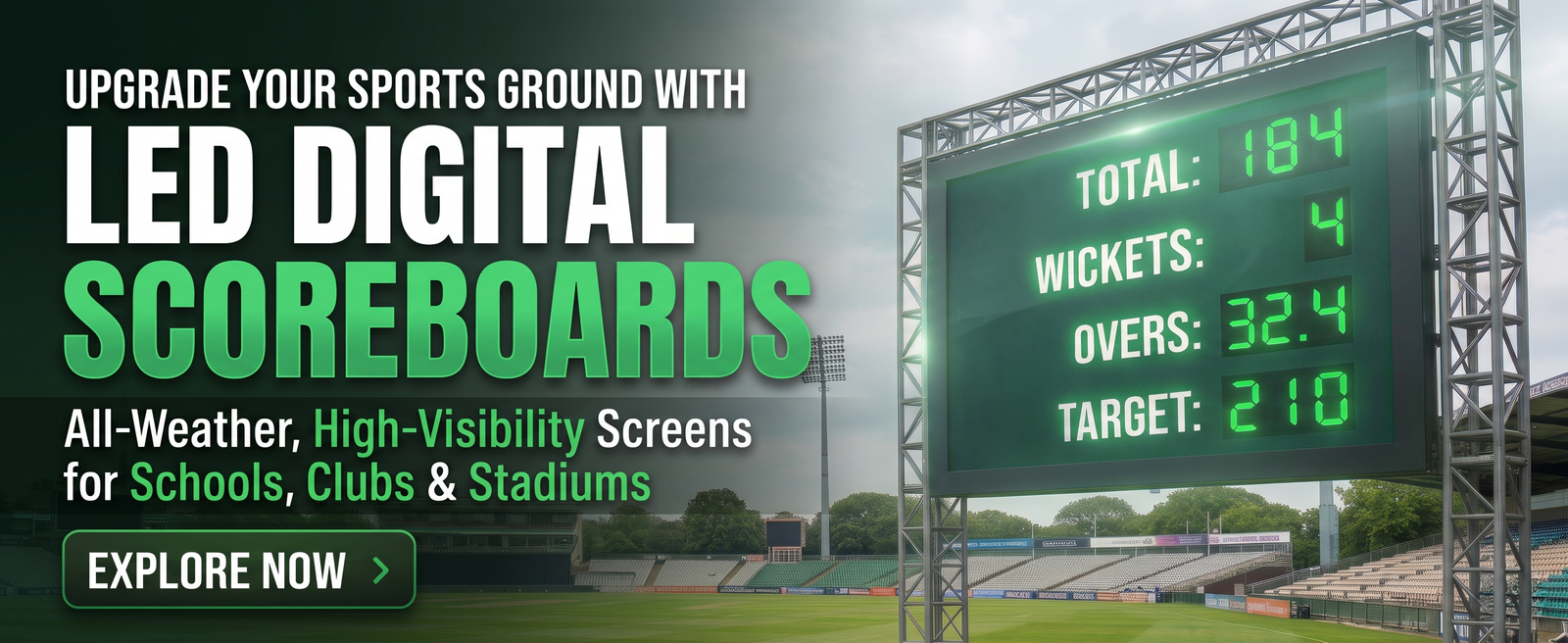
For instance, a cricket-specific board will feature fixed sections for "Total", "Wickets", "Overs", and "Target". The text labels are often screen-printed or cut from vinyl on the acrylic/polycarbonate faceplate, while the illuminated digits behind them change via a handheld or desktop console.
Because they only light up predefined segments, these boards consume very little power, generate minimal heat, and run reliably without an external computer. However, their layout cannot be reconfigured; a cricket board cannot be adapted to show a volleyball match or display team logos.
An led video scoreboard—often called an led screen scoreboard—consists of an array of modular LED panels that form a continuous digital canvas. Instead of physical digits, the entire display surface is made up of individual pixels (red, green, and blue LEDs).
The scoring layout is driven entirely by software running on a connected computer. During a match, the screen displays a virtual scoreboard layout. Between periods or during stoppages, the operator can switch the screen to high-definition video playback, sponsor commercials, team line-ups, or public safety announcements.
Because the interface is software-driven, the same display panel can be configured for football in the morning, basketball in the afternoon, and an annual award ceremony in the evening.
Fixed-digit scoreboards do one job: they report the core numbers of a game. They cannot show dynamic graphics, player headshots, or sponsor logos.
An LED video scoreboard functions as an all-in-one broadcast and advertising medium. For sports academies and private institutions, the ability to sell advertising slots on a video screen during tournaments helps offset the original purchase cost.
Fixed scoreboards operate using a proprietary wireless remote control or a rugged push-button console that communicates via radio frequency (RF) or wired RS-485 cables. Ground staff can learn to operate them in minutes without IT expertise.
Video screen scoreboards require a PC connected to an LED video processor and sending card (such as systems from NovaStar or Colorlight). The operator needs a basic understanding of scoring software, graphic dimensions, and input switching.
An indoor led scoreboard and an outdoor led scoreboard have vastly different engineering demands:
Brightness: Indoor scoreboards operate between 800 and 1,500 nits (cd/m²). Outdoor units require a minimum of 5,000 to 7,500 nits to remain readable against direct Indian midday sunlight. Using an indoor-rated panel outdoors will result in a washed-out, illegible image.
Weather Ingress Protection (IP Rating): Indoor boards do not face rain, requiring only basic dust resistance (IP20 to IP43). Outdoor installations must have a front rating of at least IP65 to withstand heavy monsoon downpours, high humidity, and airborne dust.
Thermal Management: Outdoor displays across central and northern India must withstand ambient temperatures exceeding 45°C. Industrial-grade outdoor cabinets use integrated aluminium heat sinks or sealed forced-air ventilation to prevent diode degradation.
When evaluating an LED screen scoreboard, the most critical technical specification is pixel pitch, denoted by the letter "P" followed by the distance between diode centres in millimetres (e.g., P4, P6, P10).
Smaller Pitch (e.g., P2.5 to P4): Higher pixel density, sharper image, closer minimum viewing distance, and higher manufacturing cost.
Larger Pitch (e.g., P8 to P10): Lower pixel density, designed for long-distance viewing, and lower cost per square metre.
A standard rule of thumb for sports displays is: 1 mm of pixel pitch equals approximately 1 metre of minimum comfortable viewing distance.
Indoor Gymnasiums and Basketball Courts (10–30 m viewing distance): P3 to P5 LED video panels or 8-to-12-inch fixed digits provide crisp visibility.
Outdoor Cricket and Football Grounds (50–150+ m viewing distance): P8 to P10 LED video panels or 15-to-24-inch fixed digits ensure clear legibility from across the boundary rope without paying for unnecessary pixel density.
Rather than a fixed off-the-shelf rate, led scoreboard prices in India depend on several structural, component, and logistical variables. Quotations that appear identical on paper often differ based on the following:
Fixed-digit scoreboards are substantially less expensive than full-matrix video screens. For video scoreboards, the cabinet material plays a major role: standard powder-coated mild steel (MS) cabinets are economical but heavy, whereas die-cast aluminium cabinets offer superior weather sealing, lower weight, and rust prevention, albeit at a higher cost.
The lifespan and colour consistency of an LED display depend on the diode packaging (e.g., Nationstar, Kinglight, or unbranded alternatives) and the refresh rate driven by the integrated circuits (ICs). High-refresh-rate panels (≥3840 Hz) prevent flickering on spectator mobile cameras and broadcast television feeds.
Outdoor scoreboards experience substantial wind-load resistance. The cost of structural engineering—including concrete footings, structural steel framing, wind-bracing, and crane hiring—can account for 20% to 35% of the total project budget.
Indian power grids frequently suffer from voltage spikes and supply fluctuations. Reliable installations require commercial-grade Mean Well power supplies, dedicated servo stabilisers, earthing pits, and surge protection devices (SPDs) to prevent component failure during electrical storms.
Before finalising an order with an Indian manufacturer or system integrator, ensure the following requirements are met:
Verify Minimum Brightness: Insist on a written guarantee of at least 6,000 nits for outdoor installations, tested at peak sunlight.
Confirm IP Ingress Rating: Ensure the outdoor enclosure carries an IP65 rating on the front and at least IP54 on the rear service doors.
Assess Spare Parts Availability: Require the supplier to bundle a minimum of 2% to 5% spare LED modules, receiving cards, and power supplies from the same production batch to prevent colour mismatch during future repairs.
Check Software Licensing and Language: Verify whether the scoring software requires a recurring annual license fee and whether it supports Indian formats (e.g., custom overs, Duckworth-Lewis-Stern calculation display, or local league rules).
Inspect In-Country Service Availability: Confirm that the vendor provides local on-site technician support rather than requiring you to ship failed panels back to an overseas manufacturing hub.
Review Wind-Load Certification: For large outdoor boundary displays, ensure the structural engineering drawings are signed off by a certified structural engineer to withstand regional monsoon wind speeds.
Immediate Visibility: High-lumen LEDs cut through midday haze, harsh stadium floodlights, and low-light evening games.
Operational Efficiency: Electronic scoreboards eliminate the safety hazards and delays associated with manual number-hanging or painted boards.
Commercial Returns: Video-capable displays provide schools, colleges, and clubs with a platform to display sponsor logos and generate match-day revenue.
Long Operational Life: Quality LED diodes offer operational ratings between 50,000 and 100,000 hours under standard maintenance conditions.
Capital Cost: High-resolution outdoor video screens require a notable upfront capital budget compared to static boards.
Power Dependency: Digital displays require an uninterrupted power supply (UPS) or dedicated generator backup to prevent data loss or shutdowns during match play.
Environmental Wear: In coastal or industrial belts of India, high humidity and salt spray accelerate corrosion if non-treated steel cabinets or unsealed electronics are used.
For schools, colleges, and single-sport grounds with budgets focused strictly on match administration, a fixed-digit outdoor or indoor led scoreboard is the most practical choice. It offers low maintenance, simple push-button operation, and reliable scorekeeping without requiring dedicated computing equipment or IT personnel.
For multi-sport stadiums, private sports complexes, and commercial academies, an LED video scoreboard is the superior long-term investment. While the initial capital expenditure is higher, its versatility across different sports, compatibility with live video feeds, and capacity for sponsor advertising make it far more valuable over its operating lifecycle.
Most commercial-grade LED scoreboards have an operational lifespan of 50,000 to 100,000 hours, depending on component quality, operating brightness levels, and ambient heat dissipation. Under standard sports facility usage, this translates to 7 to 10 years of reliable service.
No. Indoor LED scoreboards lack the necessary water ingress protection (minimum IP65) and have a brightness level (usually under 1,500 nits) that renders them virtually unreadable in direct daylight. Using an indoor display outdoors also risks permanent water damage from rain and ambient humidity.
Fixed-digit scoreboards are operated via handheld RF wireless remotes or wired desktop consoles with tactile buttons. LED video scoreboards are managed through a laptop or desktop computer running sports scoring software connected to an LED video processor.
For outdoor cricket grounds where the nearest spectators and players are seated 50 to 100 metres away, a pixel pitch between P8 and P10 offers an optimal balance between visual clarity and cost. Paying for a finer pitch like P3 or P4 on a large outdoor boundary screen increases costs without providing a noticeable improvement in readability at that distance.
Modern LED scoreboards are built using modular tiles. If a module fails, it can be disconnected and swapped out from the front or rear in a few minutes without replacing the entire display. The faulty module can then be repaired separately at the component level.
Yes. Because an LED video scoreboard is a full-colour screen driven by software, operators can switch layouts instantly from cricket to football, basketball, hockey, or tennis simply by launching a different sport preset in the scoring application.
Power consumption varies with screen size and brightness. On average, an outdoor LED video screen consumes approximately 250 to 350 watts per square metre during typical operation, with peak consumption reaching 600 to 800 watts per square metre when displaying a full white screen at maximum brightness.
Yes, provided the display is rated for outdoor use with a brightness of at least 5,500 to 7,500 nits. Displays with lower brightness levels will appear washed out and unreadable during bright daylight hours.