March 27, 2026 Manisha Maurya
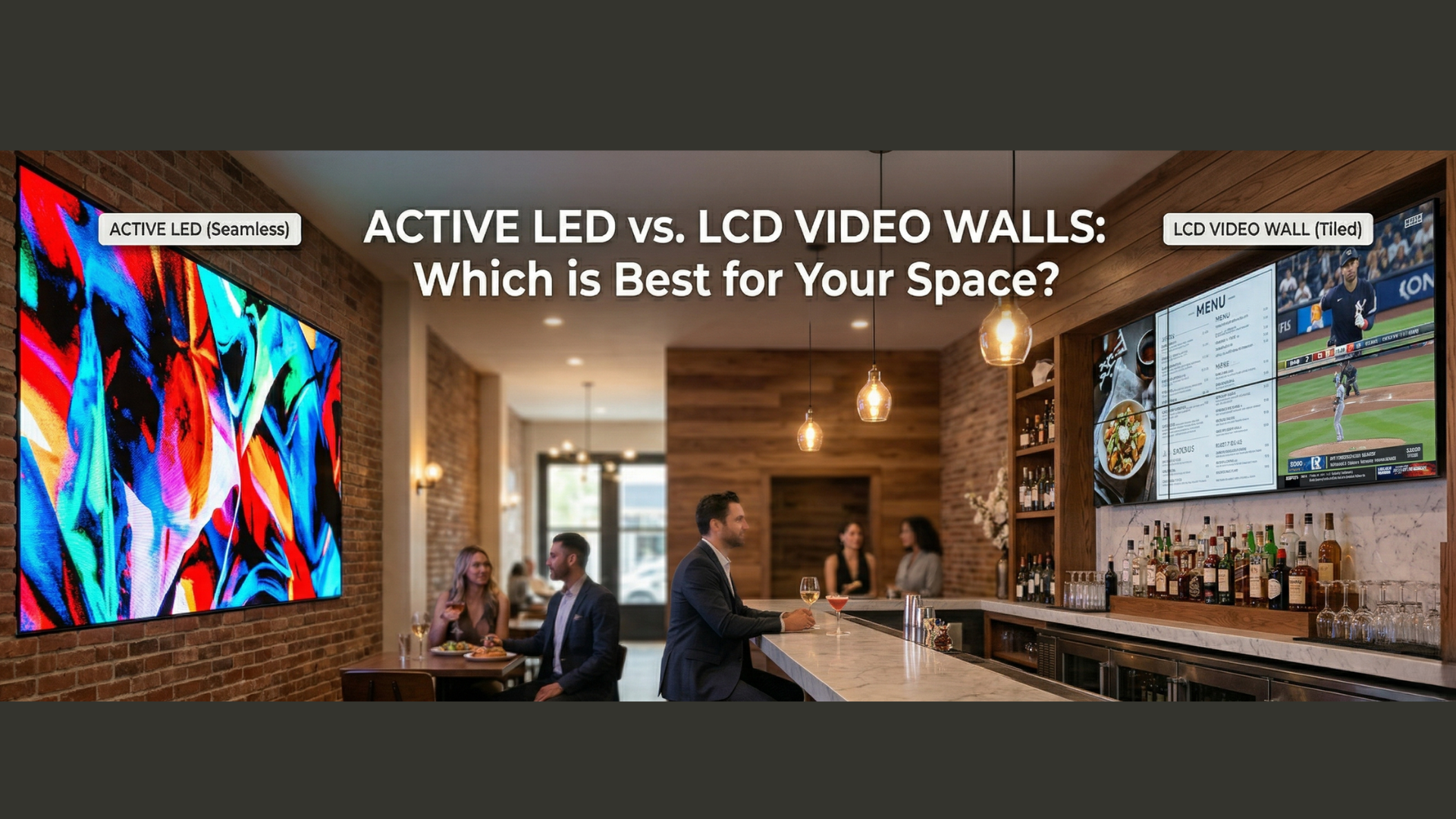
Choosing the right video wall can completely transform your commercial space, control room, or retail storefront. But with display technology advancing rapidly, the choice isn't as simple as picking the biggest screen.
Today, the decision almost always comes down to two dominant technologies: Active LED (Direct View LED) and LCD (Liquid Crystal Display).
Both produce stunning visuals, but they operate entirely differently, impacting everything from your initial budget to the viewer's experience. Let’s break down the pros, cons, and ideal use cases for each to help you make the right investment.
An LCD video wall is created by tiling together multiple specialized commercial LCD monitors. Unlike the TV in your living room, these panels are built with ultra-narrow edges to minimize the grid-like appearance when stacked horizontally and vertically.
LCD technology relies on a backlight shining through a layer of liquid crystals and color filters to create an image.
Pros of LCD Video Walls:
High Resolution at Close Range: LCD panels inherently offer high pixel density (like 4K resolution per panel), making text and fine details crisp even when viewed from a few feet away.
Lower Upfront Cost: LCD technology is mature and mass-produced, making it the most budget-friendly option for large-scale displays.
Standardized Formats: 16:9 aspect ratios make it easy to map standard video content to the wall.
Cons of LCD Video Walls:
Visible Bezels: Even with "ultra-narrow" bezels (as thin as 0.88mm), the grid lines between panels are always visible.
Lower Brightness: LCDs struggle to compete with direct sunlight, making them less ideal for brightly lit atriums or window-facing displays.
Color Uniformity Issues: Over time, individual LCD panels can age at different rates, requiring frequent color calibration.
Active LED—often called Direct View LED (dvLED)—eliminates the LCD panel and the backlight entirely. Instead, the wall is made up of modular cabinets filled with millions of microscopic, individual light-emitting diodes that produce both color and light directly.
Because the modules fit together perfectly, they create a single, continuous canvas of any size or shape.
100% Seamless: No bezels, no grid lines. The image is entirely uninterrupted.
Extreme Brightness & Contrast: LEDs produce their own light and can achieve absolute black (by turning the diode off), resulting in superior contrast and enough brightness to fight direct sunlight.
Custom Shapes & Sizes: Because they are built from small modules, LED walls can be curved, wrapped around columns, or built in non-standard aspect ratios.
Longer Lifespan: LEDs generally outlast LCDs, often rated for 100,000 hours of use with better brightness retention.
Higher Upfront Cost: The cost per square foot is significantly higher than LCD, especially for "fine pixel pitch" screens (screens designed to be viewed up close).
Complex Installation: Requires specialized mounting and meticulous alignment by AV professionals.
Heat Output: Large, high-brightness LED walls can generate more heat, requiring proper ventilation.
To make your decision easier, here is how the two technologies stack up across five critical categories:
| Feature | LCD Video Wall | Active LED (dvLED) |
| Seams / Bezels | Visible grid lines | 100% Seamless |
| Brightness | Moderate (300 - 700 nits) | Very High (800 - 3000+ nits) |
| Viewing Distance | Excellent for close viewing | Requires fine pixel pitch for close viewing |
| Lifespan | ~50,000 to 60,000 hours | ~100,000 hours |
| Upfront Cost | Lower / Budget-friendly | Higher / Premium investment |
The right choice ultimately depends on your physical environment, viewer distance, and use case.
Winner: Active LED
Why: Lobbies usually have massive windows and high ambient light. The superior brightness of Active LED cuts through the glare. Plus, the seamless look offers the premium "wow factor" corporations want for brand building.
Winner: LCD (Usually)
Why: Operators sit very close to the screens monitoring intricate data, maps, and small text. The high pixel density of LCDs at a lower cost makes them ideal, and operators quickly learn to ignore the bezels. (Note: Fine-pitch LED is starting to replace LCD here, but at a high cost).
Winner: Active LED
Why: To catch the attention of foot traffic outside, you need massive brightness to combat the sun. LED is the only technology that remains vibrant in direct sunlight.
Winner: Tie (Depends on Budget)
Why: For a standard boardroom where people are viewing presentations from 5 to 10 feet away, a large LCD wall (or even a single massive 98-inch LCD panel) is highly cost-effective. However, high-end boardrooms are increasingly opting for "all-in-one" 130-inch seamless LED displays for a cleaner aesthetic.
When choosing between an Active LED and an LCD video wall, let your space and your audience dictate the technology.
If you are on a strict budget, need to display highly detailed text, and don't mind thin grid lines, an LCD video wall is a reliable, cost-effective workhorse. However, if you want a seamless, high-impact display, have a brightly lit environment, and are looking for a long-term investment, Active LED is undoubtedly the future-proof choice.
Still not sure which pixel pitch or panel size fits your wall? Our AV integration experts are here to help. [Contact Us Today for a Free Site Consultation and Quote] to find the perfect display solution for your business.
Are LED and LCD video walls the same thing?
No. LCD walls use individual panels with liquid crystals and backlights, resulting in visible seams between screens. Active LED walls use millions of tiny, self-illuminating diodes on a modular frame, creating a completely seamless image.
Which is more expensive: LED or LCD video walls?
Active LED video walls are generally more expensive upfront than LCD video walls, particularly if you require a tight "pixel pitch" for close-up viewing. However, LED walls often have a longer lifespan and lower maintenance costs over time, making their Total Cost of Ownership (TCO) highly competitive.
What is pixel pitch in an LED video wall?
Pixel pitch is the distance (in millimeters) from the center of one LED cluster to the center of the next. A smaller pixel pitch (e.g., 1.2mm) means higher resolution and is better for close viewing. A larger pixel pitch (e.g., 4.0mm) is cheaper but requires the audience to stand further back so the image doesn't look pixelated.
Can LCD video walls be completely seamless?
No. Even the most advanced LCD panels require a physical frame (bezel) to hold the liquid crystals and electronics in place. While ultra-narrow bezels are less than 1 millimeter thick, the grid lines will always be slightly visible.
By Elactree Technical Team, Audio-Visual Solutions Expert
we've designed and installed hundreds of digital displays across corporate, retail, and broadcast environments. In this guide, we break down the exact criteria we use to advise our clients.

 Interactive flat Panel
Interactive flat Panel
Interactive flat Panel
Interactive flat Panel
Interactive flat Panel
 Interactive flat Panel