March 12, 2026 Manisha Maurya
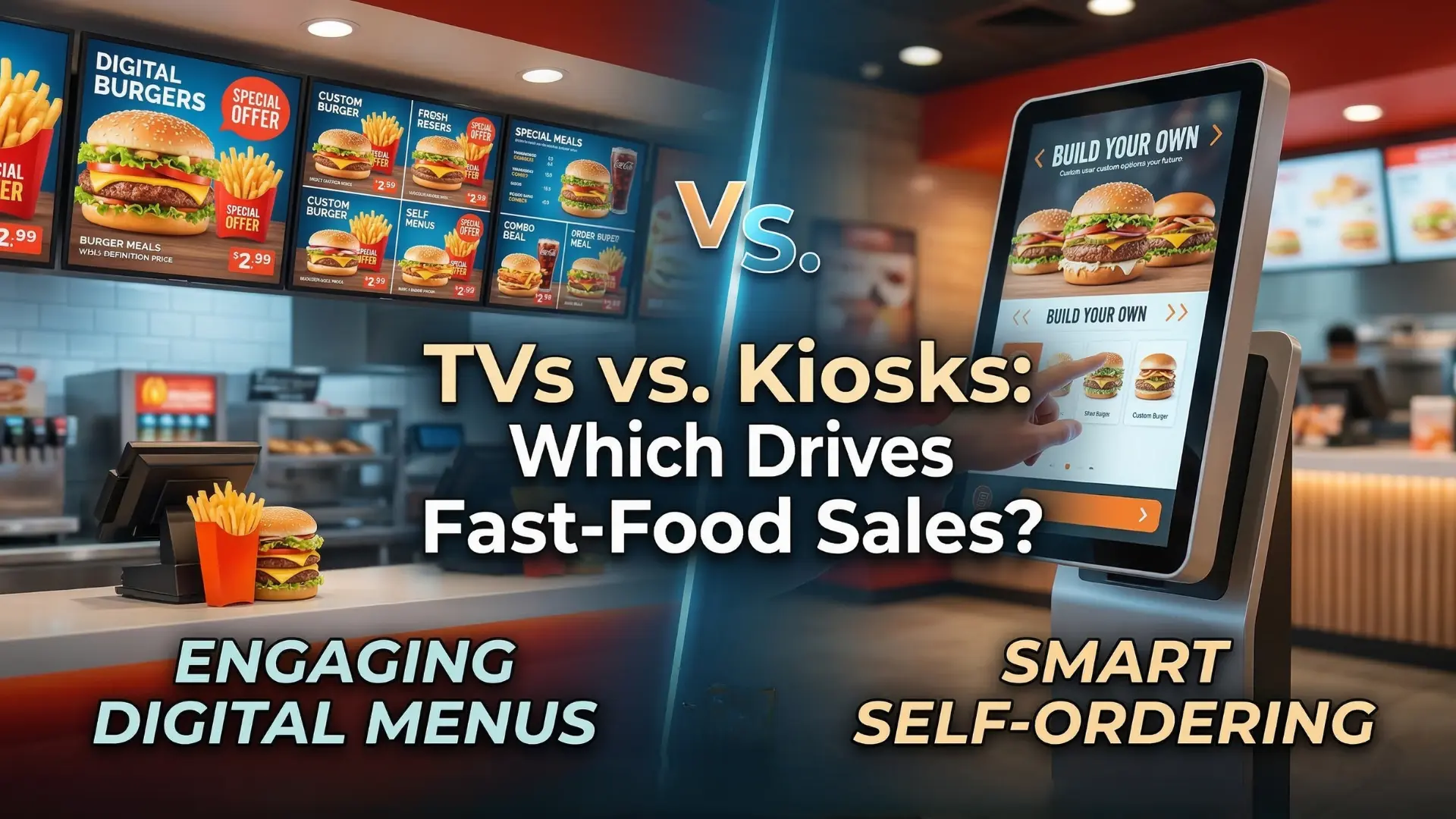
In the highly competitive world of fast food and Quick Service Restaurants (QSRs), capturing customer attention and moving them efficiently through the ordering process is the name of the game. If you are looking to upgrade your restaurant's technology, you are likely weighing two major options: commercial TVs (digital menu boards) and interactive digital kiosks.
But when it comes down to the bottom line, which technology actually drives more sales? Let's break down the benefits, use cases, and sales-driving potential of each.
The fast-food industry has rapidly moved away from static, printed signs. Digital displays offer the flexibility to change prices instantly, promote limited-time offers (LTOs), and display mouth-watering, high-definition videos of your food. However, passive viewing and interactive ordering serve two very different psychological purposes for your customers.
Commercial TVs are heavy-duty screens designed to run 16 to 24 hours a day without screen burn-in. In a fast-food setting, they are primarily used as digital menu boards behind the counter or in the drive-thru.
Commercial TVs excel at top-of-funnel marketing within your restaurant. They grab attention the moment a customer walks in.
Visual Upselling: High-definition videos of a sizzling burger or a frosted beverage can trigger impulse purchases before the customer even reaches the register.
Menu Dayparting: You can automatically switch from breakfast to lunch menus, ensuring customers only see what is currently available, which speeds up the decision-making process.
While commercial TVs are excellent for branding and guiding the customer, they are still passive. The actual transaction relies on a human cashier. If the line is too long, the beautiful digital menu board won't stop a customer from walking out the door.
Digital kiosks are interactive touchscreens where customers can browse the menu, customize their orders, and pay directly without interacting with a cashier.
Kiosks put the power of the transaction directly into the customer's hands. Brands like McDonald's and Taco Bell have heavily invested in this technology, and for a very specific reason: it works.
When customers order at a kiosk, they don't feel rushed by a line forming behind them or judged by a human cashier for adding extra bacon and a large dessert. This psychological comfort leads to a measurable increase in order size.
Studies consistently show that digital kiosks drive higher average ticket sizes. Why? Because a kiosk never forgets to upsell. It will prompt every single customer with "Would you like to make that a meal?" or "Add a side of fries for $1?"—achieving a 100% upselling consistency that human staff simply cannot match.
While commercial TVs are essential for modernizing your restaurant's look and speeding up the line, digital kiosks are the clear winner for directly driving more sales. Kiosks actively increase the average order value (AOV) through automated, consistent upselling and by offering a pressure-free ordering environment. Commercial TVs support the sale by making the food look appealing, but the kiosk actually closes a larger sale.
For maximum revenue generation, the most successful fast-food restaurants don't choose just one; they use both. Use commercial TVs to draw customers in and promote high-margin items, and use digital kiosks to process the orders, shorten wait times, and execute the final upsell.
Yes. Industry data shows that self-ordering kiosks can increase average ticket sizes by 15% to 30%. This is largely due to automated upselling prompts and customers feeling less rushed when customizing their orders.
It is highly discouraged. Consumer TVs are built to run for a few hours a day. In a restaurant environment, grease, heat, and running a static image for 15+ hours will quickly cause screen burn-in and hardware failure. Commercial TVs are built specifically to withstand these conditions.
Depending on your foot traffic and the resulting increase in average order value, many fast-food restaurants see a full ROI on their kiosk investment within 6 to 12 months.
No. Most restaurants redeploy their cashiers to different areas, such as food preparation, quality control, or table service. Kiosks help handle the rush hours efficiently without needing to hire additional staff just for the register.
If budget is your primary constraint, starting with Commercial TVs (digital menu boards) is the more affordable entry point to digitize your restaurant. Once you generate more revenue, you can reinvest those profits into a self-ordering kiosk system.

 Interactive flat Panel
Interactive flat Panel
Interactive flat Panel
 Interactive flat Panel
 Interactive flat Panel