March 11, 2026 Manisha Maurya
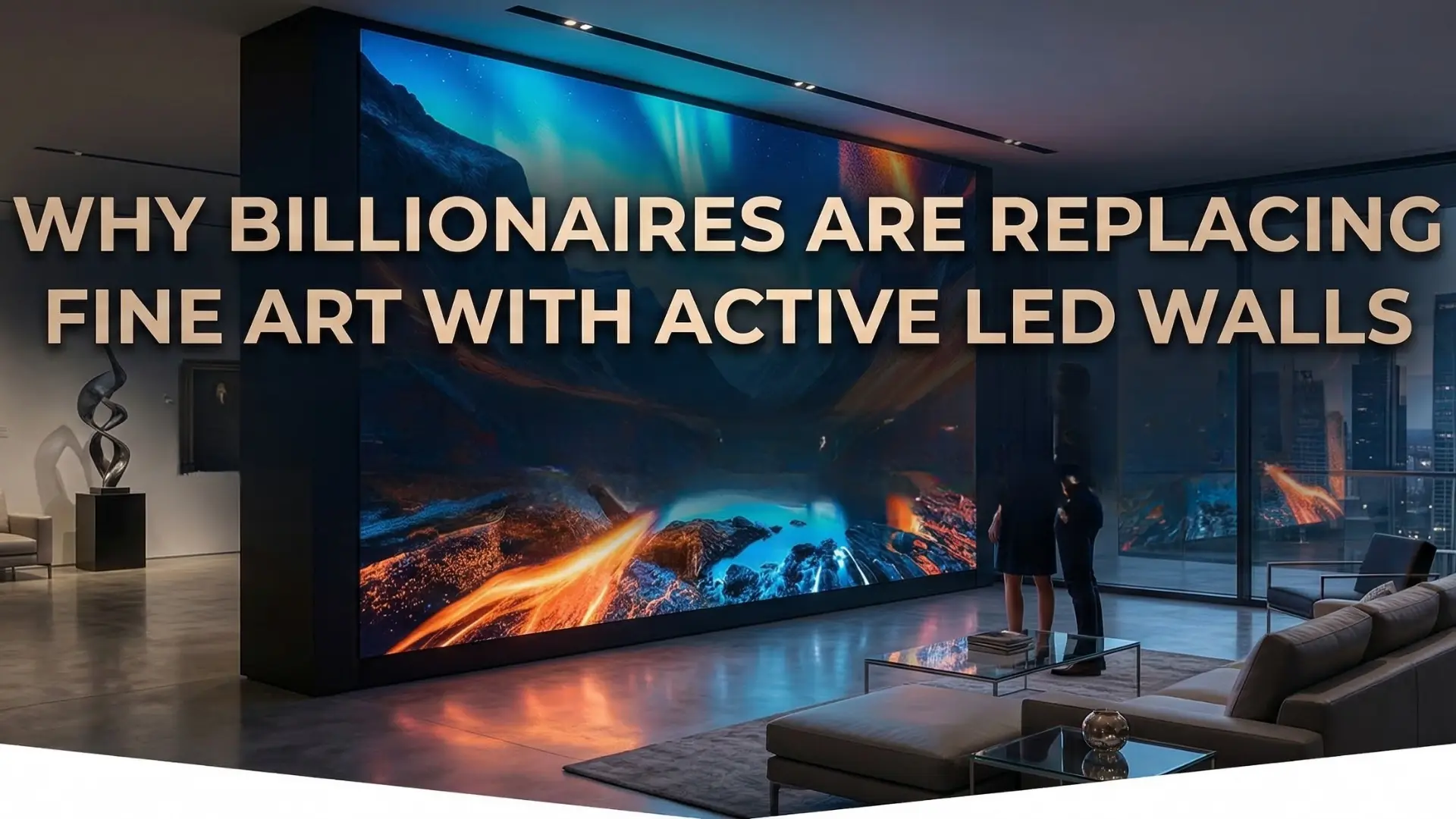
In the world of the ultra-high-net-worth, status has long been defined by the presence of a "Blue Chip" masterpiece hanging in the foyer. But a tectonic shift is occurring in luxury interior design. Static canvases by Monet or Rothko are being moved to climate-controlled storage, replaced by sprawling, seamless Active LED Walls.
This isn't just about watching TV on a bigger screen; it’s about a fundamental change in how the elite interact with their environment.
For centuries, fine art was the ultimate flex because of its scarcity. However, in a digital-first era, static art has a limitation: it never changes. Billionaires are now opting for MicroLED technology, which offers a modular, bezel-less experience that can span entire hallways or double-height living rooms.
Why own one masterpiece when you can own ten thousand? With high-end digital art platforms, homeowners can rotate their entire collection at the touch of a button.
Morning: A calming, generative ambient piece that mimics the sunrise.
Evening: A high-definition scan of a Renaissance classic.
Party Mode: A 3D motion-graphic installation that reacts to the music.
Active LED walls allow for "digital windows." In penthouses where a view might be obstructed, billionaires are installing floor-to-ceiling LEDs that stream live, 8K footage from the Maldives or the Swiss Alps, perfectly synced to the local time and lighting.
Unlike the LED TVs you find at a local retailer, these "Active" walls use Direct-View LED (dvLED) or MicroLED technology.
Perfect Blacks: The contrast ratios rival the deep shadows of an oil painting.
No Size Limits: Since they are modular, they can be built to any aspect ratio—curved, wraparound, or ceiling-mounted.
Longevity: These displays are rated for 100,000 hours of use, ensuring the "investment" lasts decades.
These walls are often integrated into the home’s smart system (like Crestron or Savant). When the art "changes," the room's smart lighting, temperature, and even scent diffusers can adjust to match the mood of the digital piece.
While the "NFT craze" has leveled off, the concept of verifiable digital ownership remains. Owning a 1-of-1 digital sculpture by a world-renowned digital artist requires a medium worthy of the work. A standard TV doesn't cut it; an Active LED wall provides the canvas these high-value digital assets require.
While prices vary by size and pixel pitch, a high-end residential MicroLED wall typically starts at $150,000 and can easily exceed $1,000,000 for whole-wall installations.
No. Unlike TVs, these are "active" modular panels with no bezels (seams). They offer much higher brightness, allowing them to look crisp even in rooms with direct sunlight, unlike traditional projectors or OLED TVs.
They do require significant power, but modern MicroLED technology is surprisingly efficient. However, most installations require dedicated cooling systems and a specialized electrical sub-panel.
Not at the "Pixel Pitch" used in luxury homes. Most high-end walls use a pitch of 0.9mm or less, meaning that from a few feet away, the image looks as smooth and continuous as a physical painting.
Unlikely. Physical art will always have historical value. However, LED walls are becoming the preferred medium for contemporary expression and "experiential" luxury within the home.

 Interactive flat Panel
Interactive flat Panel
Interactive flat Panel
 Interactive flat Panel
 Interactive flat Panel