February 28, 2026 Manisha Maurya
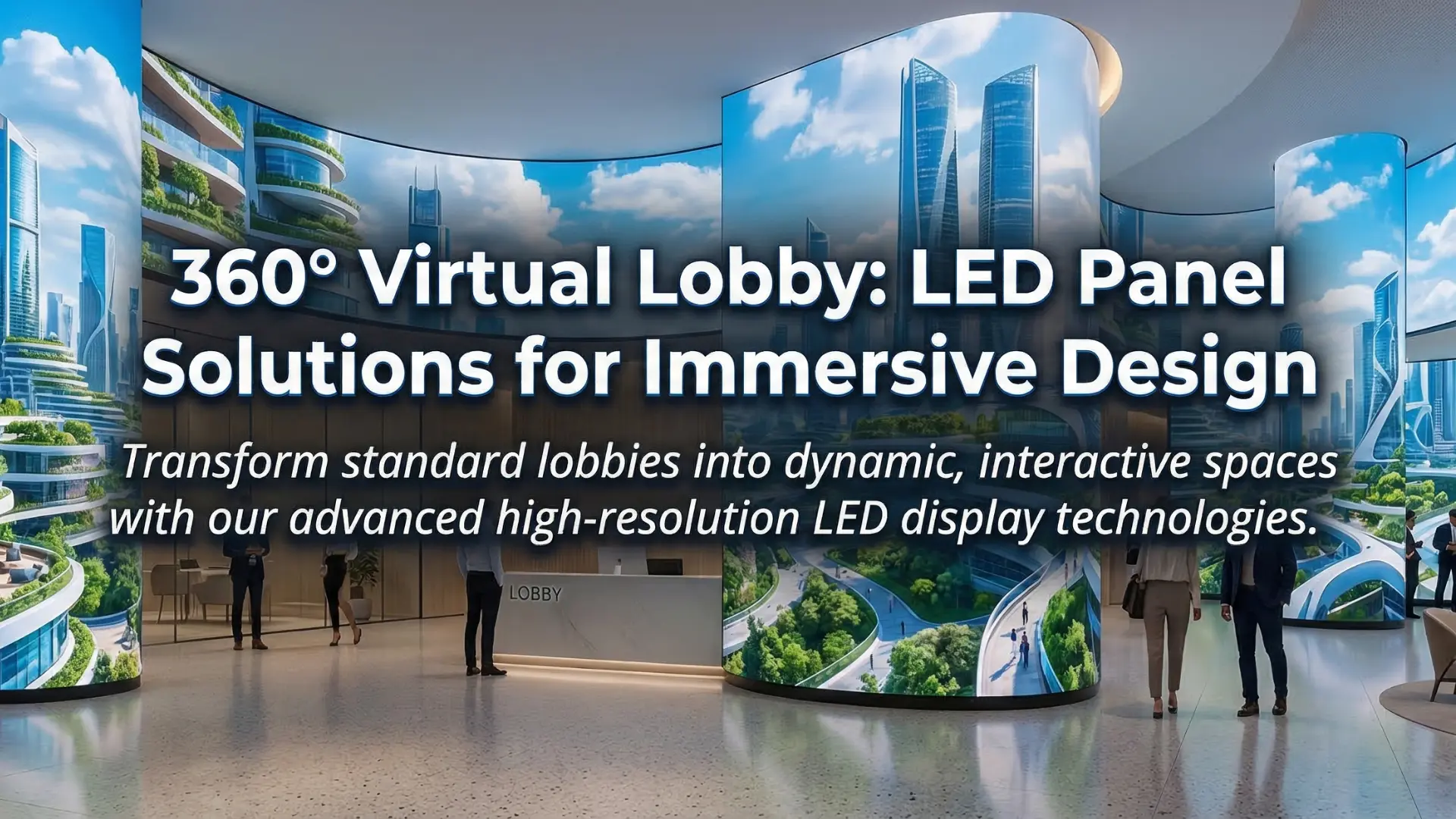
First impressions are no longer just about a firm handshake or a sleek marble desk. In the modern B2B landscape, the lobby is the first chapter of your brand’s story. By leveraging flexible LED panels, architects and AV integrators are now constructing 360° virtual rooms that transport visitors the moment they step inside.
For decades, lobbies served as waiting areas. Today, they are high-value real estate for brand immersion. A virtual lobby uses seamless digital surfaces to replace static walls, allowing for a dynamic environment that can change from a serene forest to a high-tech data visualization center with one click.
Humans are naturally wired to respond to environmental cues. When a display wraps around the viewer's entire field of vision, the "presence" factor skyrockets. This isn't just a screen on a wall; it’s an architectural transformation.
Standard LED cabinets are rigid, heavy, and limited to flat surfaces. To create a truly immersive, circular, or curved room, you need flexible LED technology.
Pliability: They can bend to create concave or convex curves, perfect for rounding off corners.
Lightweight Design: Easy to mount on diverse architectural structures without massive reinforcements.
Seamless Integration: High refresh rates and tight pixel pitches ensure the "seams" between panels are invisible to the naked eye.
Building a 360° virtual room requires a blend of creative vision and technical precision.
For indoor lobbies where visitors stand close to the walls, a fine pixel pitch (typically between 1.2mm to 2.5mm) is essential to maintain image clarity.
To achieve a 360° effect, the content must be rendered across multiple controllers perfectly. This usually involves a powerful media server capable of handling massive resolutions.
Flexible panels allow for:
Pillars and Columns: Wrapping existing structural elements in digital skin.
Cylindrical Rooms: Creating a "portal" effect.
S-Curves: Guiding visitor flow through the space.
How are industries actually using these virtual rooms?
Corporate Headquarters
Showcase global impact by surrounding clients with real-time data or 3D product simulations.
Walk prospective buyers through a 360° digital twin of a building that hasn’t been built yet.
Create "Instagrammable" moments that drive organic brand awareness.
The "Immersive Lobby" is more than a trend; it’s a shift toward experiential architecture. By utilizing flexible LED panels, businesses can break free from the constraints of flat screens and build environments that truly resonate.
1. How tight can a flexible LED panel bend?
Most high-quality flexible LED modules can achieve a minimum bend radius of about 150mm to 300mm, depending on the specific model, allowing for tight curves around pillars or sharp architectural corners.
2. Is the content for 360° rooms difficult to produce?
It requires specialized "equirectangular" or multi-surface rendering. Most firms work with digital agencies that specialize in anamorphic or 360-degree content to ensure the perspective looks correct from every angle.
3. How do you maintain a 360° LED wall?
Most flexible panels are designed for front-serviceability. This means individual modules can be popped out using a magnetic tool, making repairs quick without tearing down the entire structure.
4. Are flexible LED panels as bright as traditional ones?
Yes. Modern flexible LEDs offer comparable brightness (usually 600–1200 nits for indoors) and color accuracy, ensuring the immersive effect works even in well-lit lobbies.
5. What is the lifespan of an immersive LED lobby?
Typically, these panels are rated for 100,000 hours of use. With proper ventilation and power management, a virtual lobby can last 8–10 years before seeing significant degradation.

 Interactive flat Panel
Interactive flat Panel
Interactive flat Panel
 Interactive flat Panel
 Interactive flat Panel