February 23, 2026 Manisha Maurya
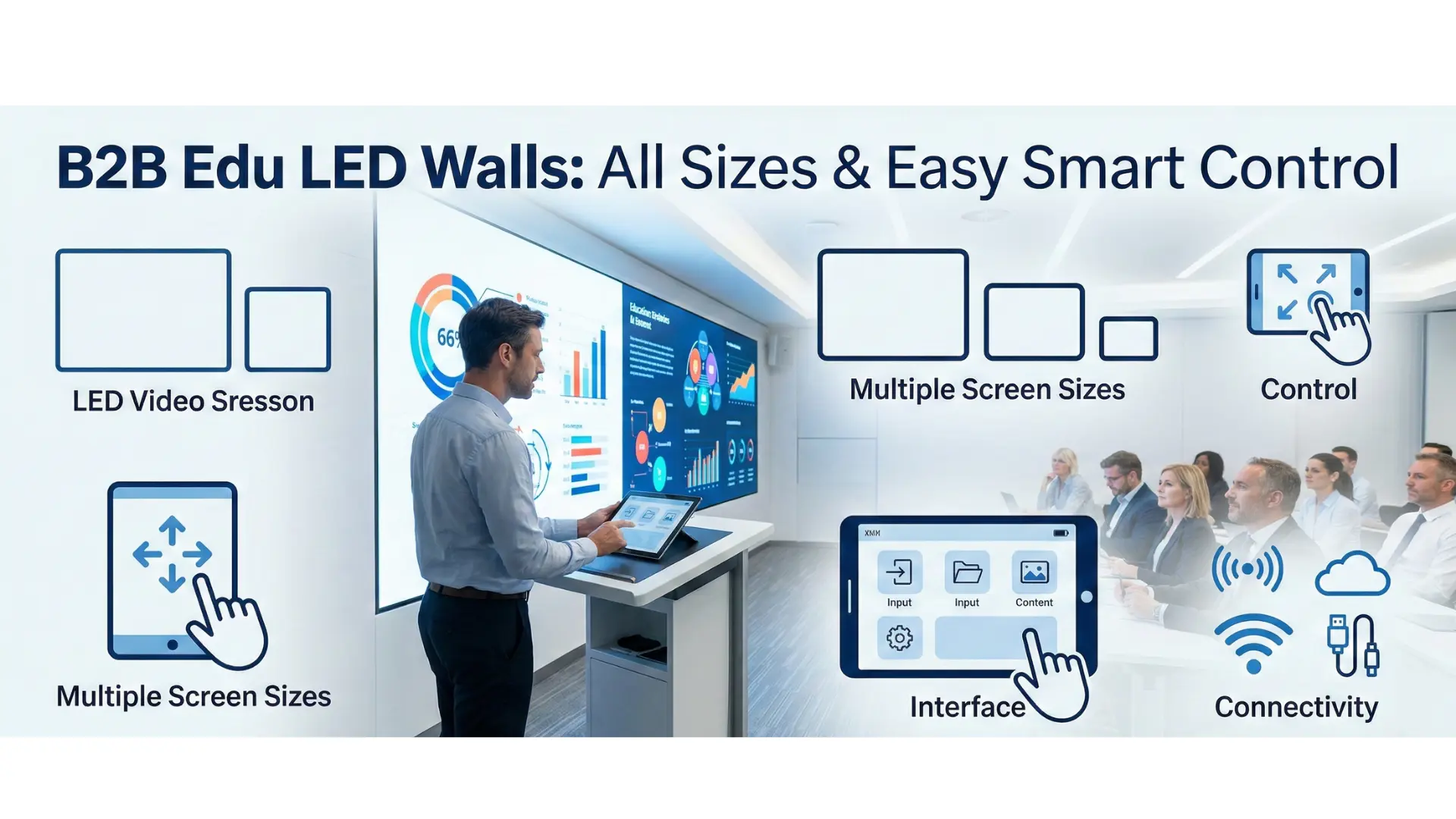
Investing in a massive visual display for your campus or educational facility used to come with an unspoken caveat: you were also investing in the endless hours of an IT professional to keep it running. Whether it was mapping inputs, fixing aspect ratios, or just turning the system on for a guest lecturer, traditional display management was a headache.
Today, that narrative has completely flipped. Thanks to intuitive smart LED control software, managing high-impact displays across a campus is as easy as sending an email.
Educational institutions—from K-12 school districts to sprawling university campuses—are rapidly upgrading their visual infrastructure. The demand for engaging, dynamic communication has led to the deployment of screens in all sizes: massive 200-inch walls in auditoriums, curved displays in administrative welcome centers, and interactive panels in individual classrooms.
But as the number and sizes of these displays have scaled, the management approach had to evolve. Facilities can no longer afford to dispatch a technician every time a screen needs a content update.
To understand why smart control is such a breakthrough, we have to look at what it replaced.
| Feature | Traditional Projectors / LCDs | Smart LED Video Walls |
| Visibility | Washed out in ambient/natural light | Grid-free, high brightness |
| Maintenance | Frequent bulb and filter replacements | 100,000+ hour lifespan |
| Management | Manual input switching in the room | Remote, cloud-based smart control |
| Scalability | Fixed, restrictive aspect ratios | Modular panels customizable to any size |
We know the feeling: you invest heavily in a beautiful, bezel-less LED wall, only to realize nobody on the teaching staff knows how to use it without calling "Dave from IT."
Relying on a full-time technician creates bottlenecks. If the tech is sick, the lecture hall display goes unused. If there’s an emergency campus announcement, disseminating it across every screen takes precious time. The true cost of an LED wall isn't just the hardware; it’s the operational friction of outdated management.
Modern smart LED control systems bypass the hardware-heavy, complex switchers of the past. Instead, they rely on intuitive, cloud-based Content Management Systems (CMS).
With a smart controller, the video wall acts as a single, giant digital canvas. Anyone with basic computer skills can log into a web portal, drag and drop a video or presentation onto the screen, and hit "publish." Want to show a live feed of a graduation ceremony alongside a real-time social media wall? Smart software handles the complex mapping automatically.
Important Note: Modern smart controllers often come with "Routine Automation," meaning you can schedule the screens to power on, play specific localized content, and power down at the end of the day—completely hands-free.
When sourcing a B2B LED solution for your educational facility, ensure the accompanying software includes:
Drag-and-Drop Interfaces: No coding or resolution-math required.
Multi-Window Layouts: The ability to split a single large wall into multiple distinct content zones.
Role-Based Access Control: Allow the marketing department to update hallway signs, but restrict auditorium controls to specific professors.
Remote Hardware Monitoring: Real-time health checks on pixel performance and power supply, accessible from a single dashboard.
1. Do we need specialized training to use smart LED control software?
No. Most modern CMS platforms (like LG webOS or VisionInfo) are designed with user-friendly, drag-and-drop interfaces. If your staff can use basic office software or upload a photo to social media, they can manage the video wall.
2. Can we control multiple video walls of varying sizes across the campus from one system?
Absolutely. Cloud-based controllers allow you to group and manage displays of all sizes—from small cafeteria menu boards to massive stadium screens—from a single centralized dashboard.
3. What happens to the display if our campus internet goes down?
Top-tier smart controllers feature local caching and offline playback. Your scheduled content will continue to play seamlessly even if the network connection is temporarily lost.
4. Are smart LED video walls energy efficient for a school's operating budget?
Yes. Modern Direct View LED (dvLED) panels consume significantly less power than older LCD arrays or high-lumen projectors. Plus, automated scheduling ensures screens are only drawing power when actually in use.
5. Can we integrate our existing emergency alert system with the video wall?
Yes. Through API integrations, smart LED software can be linked to your campus security network to instantly override standard content and display critical evacuation routes or safety alerts.

 Interactive flat Panel
Interactive flat Panel
Interactive flat Panel
 Interactive flat Panel
 Interactive flat Panel