March 18, 2026 Manisha Maurya
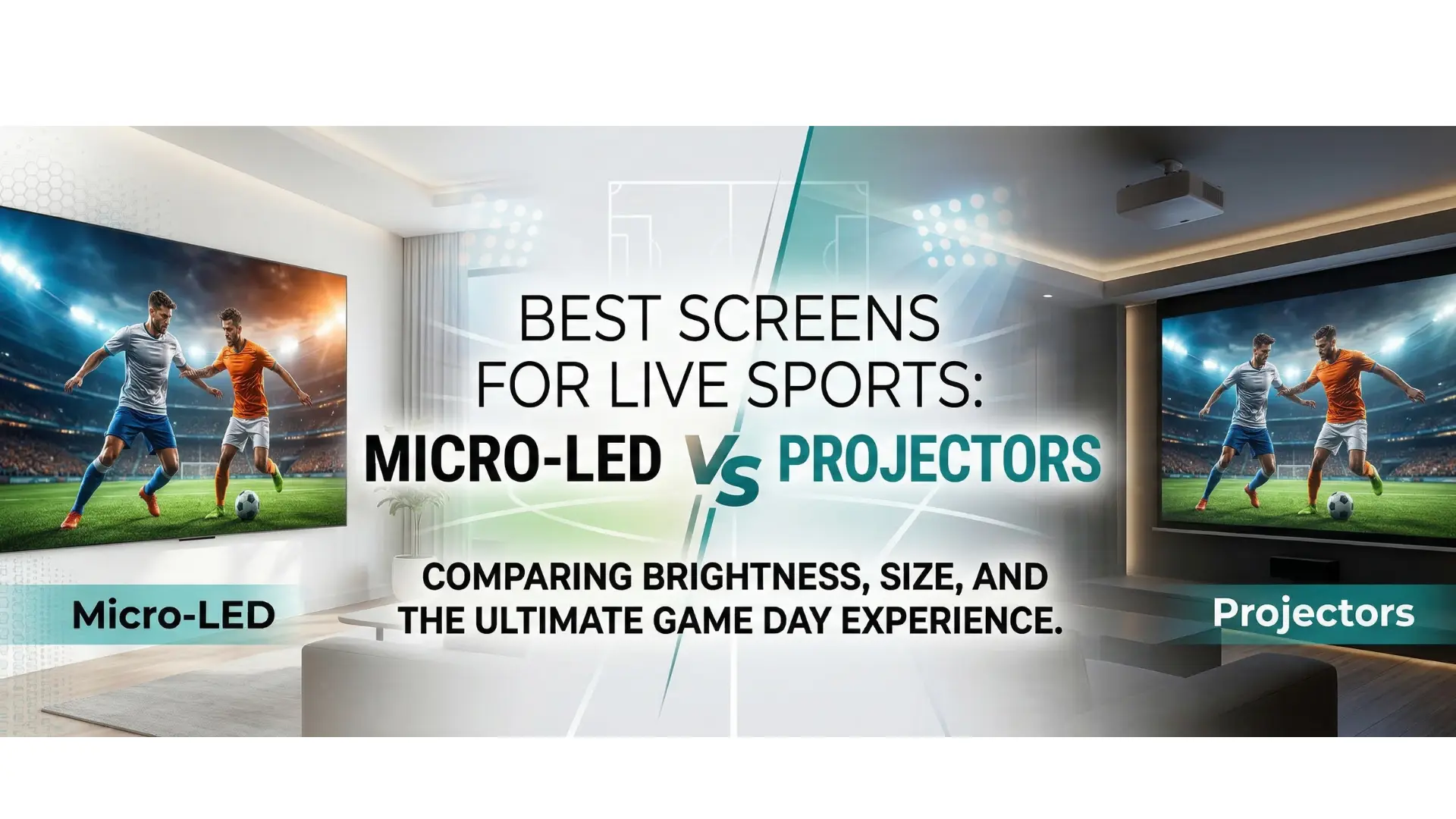
When a major tournament or championship game is on, sports bars and commercial venues become the ultimate destination for fans. However, the success of your live match screening heavily depends on one crucial factor: the quality of your displays. Patrons expect larger-than-life visuals, vibrant colors, and uninterrupted action.
If you are upgrading your commercial AV setup in 2026, the decision ultimately comes down to two dominant technologies. Let's explore the pros and cons of Curved LED displays versus commercial projectors.
For venues looking to draw a crowd, a standard consumer television simply won't cut it. You need a commercial-grade solution designed to run for hours while delivering a flawless picture to dozens, or hundreds, of viewers at once.
Modern sports fans are accustomed to high-definition 4K broadcasts. When they leave their homes to watch a game at a venue, they expect an experience that surpasses their living room setup. Providing an immersive, stadium-like atmosphere is the best way to keep patrons ordering food and drinks long after the final whistle.
Before making an investment, it is important to understand the mechanics behind these two heavy-hitting display formats.
Micro-LED is the absolute pinnacle of current display technology. Instead of relying on a backlight like traditional LCD screens, Micro-LED uses millions of microscopic, self-illuminating light-emitting diodes.
Because every single pixel generates its own light and color, they can turn off completely to create perfect, infinite blacks. This technology is often deployed in commercial spaces as Active LED video walls, which are built by seamlessly snapping together smaller modular panels to create a massive, customized screen of virtually any size.
Projectors have been the traditional go-to for massive screens. Modern commercial setups have moved away from high-maintenance bulbs and now utilize advanced laser light engines to beam images onto a specialized reflective screen.
Projectors require a clear line of sight—known as "throw distance"—between the lens and the screen. To get the best out of a laser projector in a commercial environment, it must be paired with an Ambient Light Rejecting (ALR) screen, which is designed to reflect the projector's beam back to the audience while deflecting overhead lighting.
When the venue is packed and the game is live, here is how the two technologies compare under pressure.
Sports bars are rarely dark movie theaters. They feature neon signs, overhead lights, and large windows.
Afternoon matches present the biggest challenge for venue owners. Direct sunlight can completely wash out a screen, making it impossible to see the score or the ball.
Micro-LED is the undisputed champion of bright environments. These screens can push out extreme levels of brightness that easily overpower direct sunlight, keeping the live feed vibrant and saturated no matter the time of day.
To understand this dominance, look at the "nits" (the measurement of brightness). While a great commercial projector might struggle to reflect 1,000 nits off a screen, modern Active LED video walls can consistently output well over 3,000 to 5,000 nits, ensuring the image never degrades under heavy ambient lighting.
In a crowded bar, fans are seated at all different angles.
Projectors: Can lose brightness and color accuracy if a patron is viewing the screen from a sharp side angle, as ALR screens are optimized for straight-on viewing.
Micro-LED: Offers ultra-wide, 170-degree viewing angles. The color and contrast remain perfectly uniform whether a patron is sitting dead center or at the far end of the bar.
Commercial Projectors: Offer a fantastic cost-to-size ratio. If you want a massive 120-inch screen on a tighter budget and can control the lighting in your venue, a laser projector is highly cost-effective. However, you must ensure fans won't walk in front of the beam and cast shadows.
Micro-LED: This is a premium, high-end investment. The initial cost is significantly higher. However, they require zero throw distance, have a lifespan of over 100,000 hours with almost no maintenance, and offer an unbeatable "wow" factor that establishes your venue as the premier sports destination in town.
If your venue is dimly lit and you want massive scale on a reasonable budget, a commercial laser projector will serve you well. However, if you want an indestructible, future-proof display that delivers jaw-dropping, daylight-beating visuals, Micro-LED (Active LED video walls) is the ultimate investment for any serious sports bar.
Yes, significantly. Micro-LED panels generate their own light at the pixel level, allowing them to achieve peak brightness levels that easily cut through harsh daylight and heavy bar lighting without washing out.
Micro-LED displays are incredibly durable, often lasting over 100,000 hours with minimal brightness degradation. Modern commercial laser projectors are also long-lasting but typically max out around 20,000 to 30,000 hours before the light engine needs servicing.
It can, but it requires specific conditions. You will need a high-lumen laser projector paired with a premium Ambient Light Rejecting (ALR) screen, and you will still likely need to pull the blinds on direct, harsh sunlight to maintain contrast.
Yes. One of the biggest advantages of Active LED technology is its modularity. The display is built using seamless magnetic tiles, meaning you can configure the screen to fit unique wall dimensions, wrap around corners, or build a massive, uninterrupted canvas.
Micro-LED provides the best viewing angles. Because ALR projector screens bounce light back toward the center of the room, side-viewing can appear dim. Micro-LED looks perfectly vibrant from almost any angle in the room.

 Interactive flat Panel
Interactive flat Panel
Interactive flat Panel
Interactive flat Panel
Interactive flat Panel
Interactive flat Panel
Interactive flat Panel